Posts

Showing posts with the label Revised Penal Code

The Crime of Espionage

Espionage has been defined as offense of gathering, transmitting, or losing information respecting the national defense with intent or reason to believe that the information is to be used to the injury of the Republic of the Philippines or to the advantage of any foreign nation. (See the opening sentence of Section 1 and other sections of Commonwealth Act No. 616) Article 117 of the Revised Penal Code provides: Art. 117. Espionage. - The penalty of prision correccional shall be inflicted upon any person who : 1.  Without authority therefor, enters a warship, fort, or naval or military establishment or reservation to obtain any information, plans, photographs, or other data of a confidential nature relative to the defense of the Philippine Archipelago; or 2.  Being in possession, by reason of the public office he holds, of the articles, data, or information referred to in the preceding paragraph, discloses their contents to a representative of a foreign nation. The penalty nex...

Using Fictitious Name and Concealing True Name

Image
Image grabbed from www.google.com Just this morning, someone was bothered because her name was used in dealing with transaction that would have an impact on her person.  If not abated, it would cause damage not only on her properties but on her identity in general. We have a law penalizing using fictitious name and concealing true name.  Accordingly, a penalty shall be imposed upon any person who shall publicly use a fictitious name for the purpose of concealing a crime, evading the execution of a judgement or causing damage. As defined, a fictitious name is an assumed name that differs from an individual's actual name (http://legal-dictionary.thefreedictionary.com/fictitious). What is the purpose of using fictitious name?  As provided, the purpose shall be for: 1.  concealing a crime;  2.  evading the executing; or 3.  causing damage. Note that the use of a fictitious name shall be for PUBLIC. What is the penalty ...

Who are Principals, Accomplices and Accessories of the Crime?

Image
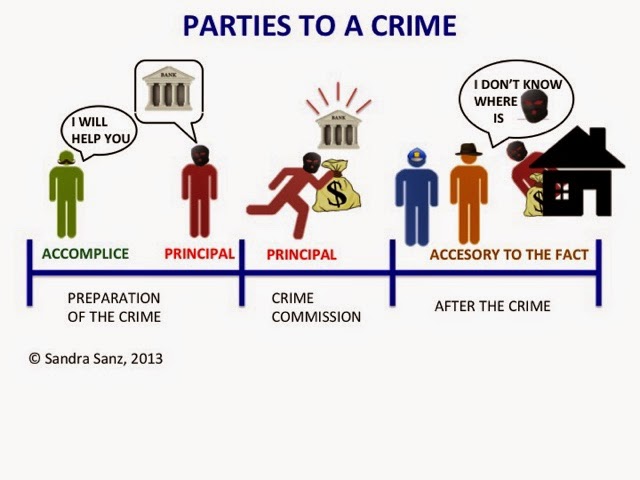
image grabbed from www.thehindu.com The words PRINCIPALS, ACCOMPLICES and ACCESSORIES of the crime/s may no longer be uncommon to most of us.  We may have heard and read these terms in the newspapers, television and nowadays in the internet. To differentiate the terms from each other, this post is trying to provide their definitions. Article 17 of the Revised Penal Code of the Philippines provides who are considered as principals. Thus: "The following are considered principals: 1.  Those who take a direct part in the execution of the act; 2.  Those who directly force or induce others to commit it; 3.  Those who cooperate in the commission of the offense by another act without which it would not have been accomplished." Based on the aforementioned, there three types of principals of the crime.  Those are principal by direct participation, principal by inducement and principal by cooperation. Whether he may participate directly, induce or coopera...

Prosecution of the Crimes of Adultery and Concubinage

Image
image grabbed from www.rappler.com In the previous posts, the differences between Adultery and Concubinage were discussed. In this post, what will be tackled is how to prosecute the aforementioned crimes.  One shall observe and must follow it, otherwise, his or her case will be doomed. taken from  knowledgeisking.ning.com As stated in Article 344 of the The Revised Penal Code , the prosecution of the crimes of adultery and concubinage shall be: 1.  The crimes of adultery and concubinage shall not be prosecuted except upon complaint filed by the offended spouse. It is clear that only the offended spouse can file the complaint of the crimes of adultery and concubinage.  In the case of adultery, the complaint shall be filed by the offended husband and by the offended wife in the case of concubinage. No other person shall file the complaint.  Not even the parents of the spouses nor the children of the parties. 2.  The offended party canno...

Prescription of Crimes

Image
This post is a reply to the query thrown by one of my followers on whether or not the crime committed in violation of anti-fencing law prescribes.  Yes, all crimes have prescriptions.  But the period of prescription may vary depending on the degree of its imposable penalties. Article 90 of the Revised Penal Code of the Philippines states the prescription of crimes.  Thus: Crimes punishable by DEATH, RECLUSION PERPETUA or RECLUSION TEMPORAL shall prescribe in TWENTY YEARS. Crimes punishable by other AFFLICTIVE PENALTIES shall FIFTEEN YEARS. Those punishable by a CORRECTIONAL PENALTY shall prescribe in TEN YEARS; with the exception of those punishable by ARRESTO MAYOR, which shall prescribe in FIVE YEARS. The crime of libel or other similar offenses shall prescribe in ONE YEAR. The offenses of oral defamation and slander by deed shall prescribe in SIX MONTHS. Light offenses prescribe in TWO MONTHS. When the penalty fixed by law is a compound one, the highest penalty shall b...

Who Would be Charged of Alarms and Scandals?

Image
If you have neighbors in your community doing any of the acts enumerated below, you may file a criminal charge against him/her or them. He/She may have committed the crime of Alarms and Scandals. The Revised Penal Code provides what constitutes the crime of Alarms and Scandals.   Said crime of Alarms and Scandals shall be charged against: 1. Any person who within any town or public place, shall discharge any firearm, rocket, firecracker, or other explosive calculated to cause alarm or danger; 2. Any person who shall instigate or take an active part in any charivari or other disorderly meeting offensive to another or prejudicial to public tranquility; 3. Any person who, while wandering about at night or while engaged in any other nocturnal amusements, shall disturb the public peace; or 4. Any person who, while intoxicated or otherwise, shall cause any disturbance or scandal in public places, provided, that the circumstances of the case shall not make the provisions on tumult...

Who May Not Be Charged As Accessories To The Crime?

Image
Image Credit to www.flashcards.barmaterials.com via Google. I am sure that most of us are already familiar with the term ACCESSORIES TO THE CRIME. I am hoping also that aside from hearing this term very often, we already have a grasp of what it conveys and how could we evade from committing it. The Revised Penal Code or Act Number 3815, as amended, provides a definition of accessories to the crime.  Accordingly, accessories are those who, having knowledge of the commission of the crime, and without participated therein, either as principals or accomplices, take part subsequent to its commission in the manner provided by law. Accessories are not principals nor accomplices to the crime. Accessories take part subsequent to the commission of the crimes in this manners: 1. By profiting themselves or assisting the offender to profit by the effects of the crime; 2. By concealing or destroying the body of the crime, or the effects or instruments thereof, in order to prevent its discove...

An 11-Year Old Girl Was Killed By Her Mother's Live-In Partner: An Example of a Parricide Crime?

Image
As reported in ABS-CBN news webpage on November 6, 2014, an 11-year old girl was shot and killed by her mother's live-in partner in Asingan, Pangasinan. Is this an example of a parricide crime? According to Article 246 of the Revised Penal Code, a parricide is committed by any person who shall kill his father, mother, or child, whether legitimate or illegitimate, or any of his ascendants, or descendants, or his spouse, and shall be punished by the penalty of reclusion perpetua to death. In the news reported by ABS-CBN, who was killed by the alleged actor was the child of his live-in partner.  Said child was not the alleged killer's child. Hence, no parricide was committed. If not parricide, what crime did the allegd killer has committed? Generally, the crime committed allegedly was homicide.  However it may be qualified into murder considering the disparity of strength, that may be explained in the age and gender differences, between the alleged killer and the victim. Note: ...

Is It Lawful to Beg? (Anti-Vagrancy Law)

Image
It is not uncommon to see persons who have no means of subsistence but beg in the streets, public plazas, within the vicinity of the churches, traffic lights and in some other public places.  Some of them would indulge into selling their reputation or into prostitution in order to survive. As a matter of fact, some of us would consider them as eye sores. An eye sore that our government has continuously adopted measures in order to address this problem.  But, it seems those measures implemented and adopted by the government were inutile as the problem worsens. Actually, the Revised Penal Code provides a penalty for such act. Legally speaking, these people are called VAGRANTS. As defined, vagrants are: 1.  Any person having no apparent means of subsistence, who has the physical ability to work and who neglects to apply himself or herself to some lawful calling; 2.  Any person found loitering about public or semi-public buildings or places or tramping or wandering about...

The Crime of Malicious Mischief: One of the Crimes Faced by It's Showtime Host Billy Crawford

Image
A photo of actor Billy Crawford when he was arrested for the crime of malicious mischief taken from google.com. What has disturbed the seemingly good image of It's Showtime Host Billy Joe Crawford was the filing of several criminal charges against him.  Allegedly, Crawford caused damage to the sliding door of one of the police stations in Taguig City last weekend. One of these criminal cases is MALICIOUS MISCHIEF. For the common people, this post would discuss what Malicious Mischief is. The Revised Penal Code of the Philippines, particularly Article 327, provides who are liable for malicious mischief.  Accordingly, any person who shall deliberately cause to the property of another any damage not falling within the definition of an arson case, shall be guilty of malicious mischief. So, any damage caused by one person to another property is already a malicious mischief, provided that said damage shall not be qualified as ARSON.  Arson, on the other hand,...

Laws on Abortion

Image
Wikipedia defines abortion as  the termination of  pregnancy  by the removal or expulsion from the  uterus  of a  fetus  or  embryo  before  viability .   An abortion can occur spontaneously, in which case it is often called a  miscarriage , or it can be purposely  induced . The term  abortion  most commonly refers to the induced abortion of a human pregnancy ( http://en.wikipedia.org/wiki/Abortion ). This picture is taken from this site  http://www.advocatesoflife.com/graphicabortionimages.htm In the Philippines, abortion is penalized under the Revised Penal Code of the Philippines.  It is not legal and therefore any person who promotes this act shall be penalized. Based on the Revised Penal Code, the criminal act of abortion may be termed as INTENTIONAL or UNINTENTIONAL ABORTION. Article 256 of the Revised Penal Code states the penalty for any person committing an intentional abortio...

Beware of Buying Secondhand Goods, To Avoid Violating Anti-Fencing Law of 1979

Image
Before you buy a secondhand item or goods, you have to make it sure that the same came from a legitimate source, otherwise, you might be indicted with the crime violating an Anti-Fencing Law of 1979.  It is common for us that we buy secondhand items or goods impulsively especially gadgets that are sold at a very low price.  Before you know it, you are buying gadgets which are relatively "GSM" or "GALING SA MAGNANAKAW" and you might see yourself defending in court. Secondhand goods sold in the market.  Courtesy of bing images.   As defined in Presidential Decree No. 1612 or otherwise known as the Anti-Fencing Law of 1979, fencing is the act of any person who, with intent to gain for himself or for another, shall buy, receive, possess, keep, acquire, conceal, sell or dispose of, or shall buy and sell, or in any other manner deal in any article, item, object or anything of value which he knows, or should be known to him, to have been derived from the pr...

On the Crime of Duel

Image
According to this website  http://dictionary.reference.com/browse/Duel,  duel is defined as a prearranged combat between two persons, fought with deadly weapons according to an accepted code of procedure, especially to settle a private quarrel. An image of duel taken from bing images. The scene of duel is very common in classic films, both foreign and local films, wherein the antagonist challenges the protagonist to do the duel.  Of course, no matter how skillful the antagonist is, it is the protagonist that would end up as a winner. Duel, as common as it may seem, is prohibited by law.  It is penalized in the Revised Penal Code of the Philippines. According to Article 260 of the Revised Penal Code: "Responsibility of participants in a duel. - The penalty of reclusion temporal shall be imposed upon any person who shall kill his adversary in a duel.    If he shall inflict upon the latter physical injuries only, he shall suffer t...

On the Crime of Bigamy

Image
Here is another advice sought by my client one day.  He is named B and working as an OFW in Italy.  For more information, please read the post below: A and B, both Filipinos, were lawfully married on February 19, 1981 in General Santos City, Philippines.  Sometime in 1995, B worked in Italy as an Overseas Filipino Worker or OFW.  While working in Italy, B met another Filipino, C.  Unfortunately, B and C fell in love with each other and they decided to get married in Italy.  Could B liable for the crime of bigamy? To answer this question, we have to define what would constitute the crime of bigamy. According to the Revised Penal Code of the Philippines, a bigamy is committed when any person who shall contract a second or subsequent marriage before the former marriage has been legally dissolved, or before the absent spouse has been declared presumptively dead by means of a judgment rendered in the proper proceedings. A picture of bigamy take...