Posts

Can We Use The Philippine Flag as a Mop?

Image
Just recently, a news was reported about a young student who used the Philippine flag as a mop in the school.  He was videoed having fun and was unmindful that he was already committing  an unlawful act.  Taken from  www.iweb.ph Under Section 34 of Republic Act No. 8491 or the Flag and Heraldic Code of the Philippines: "It shall be prohibited a.  To mutilate, deface, defile, trample, on or cast contempt any act or omission casting dishonor or ridicule upon the flag over its surface; b.  xxxxxxx" As such the student may be penalized with a fine of not less than Five Thousand Pesos (P5,000.00) but not more than Twenty Thousand Pesos (P20,000.00), or by imprisonment for not more than one (1) year, or both such fine and imprisonment, at the discretion of the court. However, if the student committing the instant offense is below 15 years old, he shall have no liability following the provisions of Republic Act. No. 9344. For mo...

What Will Happen If the Accused was Imprisoned for More than the Possible Imprisonment Prescribed for the Offense Charged?

Image
Image taken from www.illustrationsof.com I was appointed as counsel de oficio to represent an accused who was imprisoned since March 2014. Counsel de oficio is the attorney appointed by the court to an indigent criminal defendant  ( http://definitions.uslegal.com/c/counsel-de-officio/ ).  His case is still on its arraignment stage.      Arraignment is when the information or the complaint is read in the language or dialect known to the accused and then he would be asked whether he pleads guilty or not guilty. Image taken from www.dreamstime.com When I browsed the record of the case, the penalty that would be imposed is only prision mayor or imprisonment of 30 days and 1 day to 6 months.  So, the accused has already served the maximum penalty should he may be found guilty to the crime charged. In fact, his imprisonment is already beyond what is required by law. As stated section 16 of Rule 114 of Revised Rules of Criminal Procedure,...

Who are Principals, Accomplices and Accessories of the Crime?

Image
image grabbed from www.thehindu.com The words PRINCIPALS, ACCOMPLICES and ACCESSORIES of the crime/s may no longer be uncommon to most of us.  We may have heard and read these terms in the newspapers, television and nowadays in the internet. To differentiate the terms from each other, this post is trying to provide their definitions. Article 17 of the Revised Penal Code of the Philippines provides who are considered as principals. Thus: "The following are considered principals: 1.  Those who take a direct part in the execution of the act; 2.  Those who directly force or induce others to commit it; 3.  Those who cooperate in the commission of the offense by another act without which it would not have been accomplished." Based on the aforementioned, there three types of principals of the crime.  Those are principal by direct participation, principal by inducement and principal by cooperation. Whether he may participate directly, induce or coopera...

2016 Philippine Regular and Special (Non-Working) Days

Image
This photo is grabbed from www.imaginative-traveller.com As early as August 20, 2015, President Benigno S. Aquino III has signed Proclamation No. 1105 declaring the Regular Holidays and Special (Non-Working) Days for the Year 2016. For information, please be guided of these days before you click the button of any airfare promos. Regular Holidays: New Year’s Day                       1                  January (Friday) Maundy Thursday                      24                March Good Friday                              ...

Nuisance Candidates... Here's how to declare them?

Image
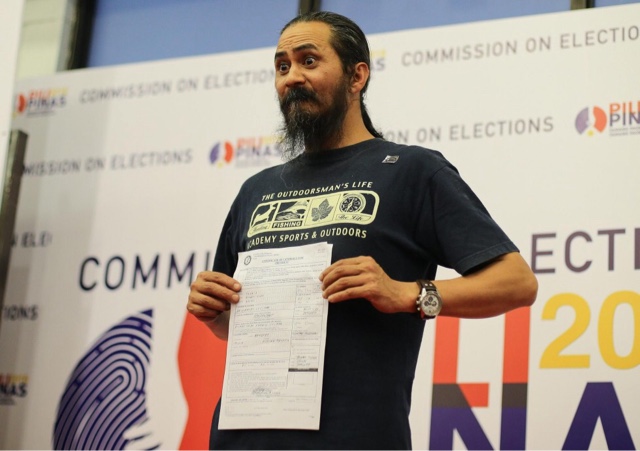
A photo of Archangel Lucifer, one of the 130 hopefules vying for Philippine President in 2016 Elections taken from www.scmp.com For information, there are 130 hopefuls filed their Certificates of Candidacy (COCs) for Philippine President in the May 2016 Elections.  It is considered as one of the 'record-breaker' according to the Commission on Elections (COMELEC). The COMELEC has the ministerial duty to accept the COC of any person vying for any position.  It has no power, based on its own judgment, to say that a certain candidate is not qualified to file a COC of a certain position.  Its act is purely ministerial and not discretionary one.  The Supreme Court of the Philippines has clearly demarcated the difference between discretionary and ministerial act in Mallari versus Banco Filipino Savings & Mortgage Bank, G.R. No. 157660, August 29, 2008.  Thus: "The distinction between a ministerial and discretionary act is well delineated. A pu...

WHAT WILL HAPPEN IF THE ACCUSED REFUSES TO ENTER HIS PLEA?

Image
In all criminal proceedings, the accused must be arraigned.  The accused must be arraigned before the court where the complaint or information was filed or assigned for trial. The arraignment shall be made in open court by the judge or clerk by furnishing the accused with a copy of the complaint or information, reading the same in the language or dialect known to him, and asking him whether he pleads guilty or not guilty (Sec. 1, Rule 116 of the Revised Rules of Criminal Procedures). The purpose of the arraignment is to inform the accused of the accusation filed against him.  Thus, it is important that it shall be done by reading in a language or dialect known to the accused.  Meaning, the information or complaint shall be interpreted or translated to the dialect or language spoken and known by the accused.  Otherwise, the arraignment is deemed not done. As stated above, the accused would be asked to enter his plea whether guilty or not guilty.  It is en...

Prosecution of the Crimes of Adultery and Concubinage

Image
image grabbed from www.rappler.com In the previous posts, the differences between Adultery and Concubinage were discussed. In this post, what will be tackled is how to prosecute the aforementioned crimes.  One shall observe and must follow it, otherwise, his or her case will be doomed. taken from  knowledgeisking.ning.com As stated in Article 344 of the The Revised Penal Code , the prosecution of the crimes of adultery and concubinage shall be: 1.  The crimes of adultery and concubinage shall not be prosecuted except upon complaint filed by the offended spouse. It is clear that only the offended spouse can file the complaint of the crimes of adultery and concubinage.  In the case of adultery, the complaint shall be filed by the offended husband and by the offended wife in the case of concubinage. No other person shall file the complaint.  Not even the parents of the spouses nor the children of the parties. 2.  The offended party canno...