Posts

Showing posts with the label Accused

What Will Happen If the Accused was Imprisoned for More than the Possible Imprisonment Prescribed for the Offense Charged?

Image
Image taken from www.illustrationsof.com I was appointed as counsel de oficio to represent an accused who was imprisoned since March 2014. Counsel de oficio is the attorney appointed by the court to an indigent criminal defendant  ( http://definitions.uslegal.com/c/counsel-de-officio/ ).  His case is still on its arraignment stage.      Arraignment is when the information or the complaint is read in the language or dialect known to the accused and then he would be asked whether he pleads guilty or not guilty. Image taken from www.dreamstime.com When I browsed the record of the case, the penalty that would be imposed is only prision mayor or imprisonment of 30 days and 1 day to 6 months.  So, the accused has already served the maximum penalty should he may be found guilty to the crime charged. In fact, his imprisonment is already beyond what is required by law. As stated section 16 of Rule 114 of Revised Rules of Criminal Procedure,...
WHAT WILL HAPPEN IF THE ACCUSED REFUSES TO ENTER HIS PLEA?

Image
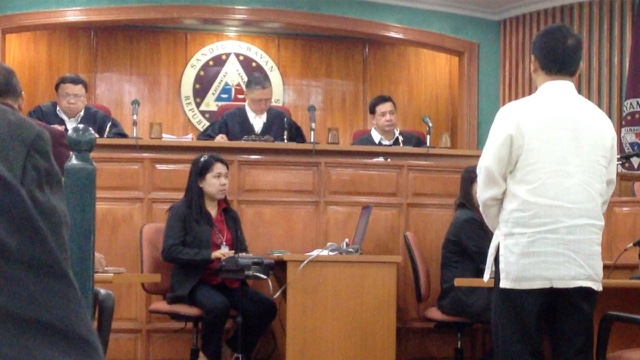
In all criminal proceedings, the accused must be arraigned.  The accused must be arraigned before the court where the complaint or information was filed or assigned for trial. The arraignment shall be made in open court by the judge or clerk by furnishing the accused with a copy of the complaint or information, reading the same in the language or dialect known to him, and asking him whether he pleads guilty or not guilty (Sec. 1, Rule 116 of the Revised Rules of Criminal Procedures). The purpose of the arraignment is to inform the accused of the accusation filed against him.  Thus, it is important that it shall be done by reading in a language or dialect known to the accused.  Meaning, the information or complaint shall be interpreted or translated to the dialect or language spoken and known by the accused.  Otherwise, the arraignment is deemed not done. As stated above, the accused would be asked to enter his plea whether guilty or not guilty.  It is en...

Provisional Dismissal?

Image
In the criminal cases I handled, most of them were dismissed provisionally.  Provisional in the sense that such dismissal is not permanent yet. When a case is dismissed provisionally, the private complainant has the right to refile the same case again against the accused without violating the double jeopardy right of the accused. In cases falling within the jurisdiction of a Municipal Trial Court, the private complainant has the right to refile the same case within one (1) year from the date of the order of the dismissal.  In the Regional Trial Court cases, the private complainant has the right to refile within a period of two (2) years. If the private complainant does not refile the case within the period mentioned above, the dismissal shall become permanent. If the dismissal is already permanent, refiling can no longer be made because it would violate the double jeopardy right of the accused. Be it noted that any provisional dismissal shall have an explicit consent of the a...

Plea Bargaining?

Image
Plea Bargaining.  It is a common scenario in criminal court. The accused may interpose a yes-guilty to a lesser offense which is necessarily included in the offense charged. However, it shall be with the consent of the offended party and the prosecutor.  Otherwise, there would be no plea bargaining. As to what stage the accused may be allowed to have a plea bargaining.  As provided in the Revised Rules of Criminal Procedure, at arraignment, the accused, with the consent of the offended party and the prosecutor, may be allowed by the trial court to plead guilty to a lesser offense which is necessarily included in the offense charged. Further, the same Rules also states that plea bargaining shall also be one of the things considered in the Pre-Trial Conference. In short, a plea bargaining is allowed for as long as the prosecutor has not offered yet any evidence to prove the guilt of the accused beyond reasonable doubt. However, in reality, some of the judges, may allow the ...

Trial In Absentia

Image
In one of the courts here in General Santos City (where I am appearing as a defense lawyer), some of the cases I inherited were tried in absentia. Trial in Absentia in the sense that trials were had in the absence of the accused. Is this not a violation of the right of the accused to be present during trials? “In all criminal prosecutions, the accused shall be presumed innocent until the contrary is proved, and shall enjoy the right to be heard by himself and counsel, to be informed of the nature and cause of the accusation against him, to have a speedy, impartial, and public trial, to meet the witnesses face to face, and to have compulsory process to secure the attendance of witnesses and the production of evidence in his behalf.” (Section 14, paragraph 2, Article III, 1987 Philippine Constitution) Due process requires for the accused to be present in all of the stages of the criminal proceeding. “However, after arraignment, trial may proceed notwithstanding the absence of the accused...

Walk of Shame: Legal Implications

When I watched the news last March 3, 2014, this http://www.abs-cbnnews.com/video/nation/regions/03/03/14/dried-fish-thief-shamed-tanauan has caught my attention. Imagine, a suspect of stealing a bunch of dried fish was ordered to walk around the supermarket of Tanauan City in Batangas wearing a brand that read like "Ako'y Magnanakaw.  Huwag Tularan."   (I am a thief, do not follow me).  Definitely, the suspect was walking in the path of shame. What has worsened the whole shameful act was the go-signal given by the mayor himself of the city according to the report. Is this walk of shame warranted by law? Due Process of Law: Every person is entitled to due process.  It is guaranteed by no less than the 1987 Constitution of the Philippines that  "No person shall be held to answer for a criminal offense without due process of law." Due process implies that every person should be given a day in court to defend or face any accusation fil...

Vhong Navarro's Defense of Alibi?

It seems that the defense of Vhong Navarro to his recent allegedly victim of rape Roxanne Acosta Cabanero is an alibi.  This is of course based only on the recent information gathered from the news recently. Accordingly, the victim was raped allegedly in the nearby vicinity of Astoria Plaza Hotel in Pasig City on the of April 24, 2010.  As reported, Vhong Navarro guested the concert of Vice Ganda which took place in Island Cove Resort in Cavite on the same night.  Please see http://www.abs-cbnnews.com/entertainment/02/23/14/vice-ganda-hotel-contradict-roxannes-rape-story for more information.  Thus, if this would be utilized by Navarro's camp, it is certainly a defense of alibi.

Miranda Rights and Constitutional Rights of the Accused

I have already defined the meaning of the accused in my previous post re: Respondent Versus Accused Versus Convict.  So if you would like to know what I am mentioning is all about, please read the said post. An accused is not yet a convict.  In the Philippine justice system, an accused is PRESUMED INNOCENT until proven otherwise.  Meaning, no matter how guilty the accused may appear, he is still innocent until the prosecution can prove his guilt beyond reasonable doubt.

Demurrer to Evidence

These past few days, I busied myself in front of my computer, laptop or even in my ipad.  Not because I was hooked lately to clumsy-flappy bird, but blame it to my caseload.  At least I have something to blame on.  I have actually 3 criminal cases due for submission of their demurrers to evidence. As a defense lawyer, preparing demurrer to evidence is one of the tedious and time-consuming parts of litigation.  You need to scavenge voluminous files of the case inorder to present a meritorious demurrer to evidence.  Because once the demurrer is impressed with merits, it will dismiss the case.

Respondent Versus Accused Versus Convict

We have always come across the terms Respondent, Accused and Convict.  From the news we saw and heard in television, from what we have read on our Facebook accounts and even from the small chika-chika we have in our friends, these terms seem ubiquitous and always present. However, from the minds of the common tao, these terms are referring to the same person.  They are associated with the person/s involved with the commission of the crime, so to speak.