Posts

Prescription of Crimes

Image
This post is a reply to the query thrown by one of my followers on whether or not the crime committed in violation of anti-fencing law prescribes.  Yes, all crimes have prescriptions.  But the period of prescription may vary depending on the degree of its imposable penalties. Article 90 of the Revised Penal Code of the Philippines states the prescription of crimes.  Thus: Crimes punishable by DEATH, RECLUSION PERPETUA or RECLUSION TEMPORAL shall prescribe in TWENTY YEARS. Crimes punishable by other AFFLICTIVE PENALTIES shall FIFTEEN YEARS. Those punishable by a CORRECTIONAL PENALTY shall prescribe in TEN YEARS; with the exception of those punishable by ARRESTO MAYOR, which shall prescribe in FIVE YEARS. The crime of libel or other similar offenses shall prescribe in ONE YEAR. The offenses of oral defamation and slander by deed shall prescribe in SIX MONTHS. Light offenses prescribe in TWO MONTHS. When the penalty fixed by law is a compound one, the highest penalty shall b...

The Philippine National Flag Days

Image
On May 28, 1898, the Philippine flag was first unfurled after the Philippine Revolutionary Army defeated Spanish forces in the Battle at Alapan, Imus, Cavite.  The national flag was yet to be formally announced on the day of that battle.  It was formally presented to the people on June 12, 1898.  From 1919, when the Philippine flag was once more legalized, until 1940, FLAG DAY was observed in October, the date the Philippine Legislature has restored the flag.  From 1941 to 1964, FLAG DAY was commemorated on the date the national flag was unfurled in Kawit: June 12. However, in 1965, since Flag Day coincided with Independence Day, in order to commemorate the date the national emblem was first unfurled in battle, President Diosdado Macapagal issued Proclamation No. 374, 1965, which moved NATIONAL FLAG DAY to May 28. On May 23, 1994, President Fidel V. Ramos issued Executive Order No. 179, stretching National Flag Day into an extended period, from May 28 to June 12, cul...

Provisional Dismissal?

Image
In the criminal cases I handled, most of them were dismissed provisionally.  Provisional in the sense that such dismissal is not permanent yet. When a case is dismissed provisionally, the private complainant has the right to refile the same case again against the accused without violating the double jeopardy right of the accused. In cases falling within the jurisdiction of a Municipal Trial Court, the private complainant has the right to refile the same case within one (1) year from the date of the order of the dismissal.  In the Regional Trial Court cases, the private complainant has the right to refile within a period of two (2) years. If the private complainant does not refile the case within the period mentioned above, the dismissal shall become permanent. If the dismissal is already permanent, refiling can no longer be made because it would violate the double jeopardy right of the accused. Be it noted that any provisional dismissal shall have an explicit consent of the a...

What GPH Peace Panel Chair Miriam Coronel-Ferrer Has to Say About the Incident in Mamasapano, Maguindanao on January 25, 2015?

Image
The following post is a statement of the GPH Peace Panel Chair Miriam Coronel-Ferrer on the armed encounter in Maguindanao on January 25, 2015 which resulted to the death of more than 40 members of Special Action Force of the Philippine National Police and various armed groups.  It is originally posted in the website of the Official Gazette of the Philippines (www.gov.ph) on January 26, 2015. The author just copied in toto the statement of Chair Coronel-Ferrer. Statement of GPH Peace Panel Chair Miriam Coronel-Ferrer:
 On the armed encounter in Maguindanao [Released on January 26, 2015] We are deeply saddened by the loss of lives in the tragic encounter in Mamasapano, Maguindanao yesterday, January 25, involving the Special Action Force of the Philippine National Police and various armed groups. Based on the reports of our ceasefire mechanisms, all efforts are being exerted to retrieve the casualties and provide safe passage to other SAF personnel who remain in the affected areas. ...

Who Would be Charged of Alarms and Scandals?

Image
If you have neighbors in your community doing any of the acts enumerated below, you may file a criminal charge against him/her or them. He/She may have committed the crime of Alarms and Scandals. The Revised Penal Code provides what constitutes the crime of Alarms and Scandals.   Said crime of Alarms and Scandals shall be charged against: 1. Any person who within any town or public place, shall discharge any firearm, rocket, firecracker, or other explosive calculated to cause alarm or danger; 2. Any person who shall instigate or take an active part in any charivari or other disorderly meeting offensive to another or prejudicial to public tranquility; 3. Any person who, while wandering about at night or while engaged in any other nocturnal amusements, shall disturb the public peace; or 4. Any person who, while intoxicated or otherwise, shall cause any disturbance or scandal in public places, provided, that the circumstances of the case shall not make the provisions on tumult...

Rights of Air Passengers

Image
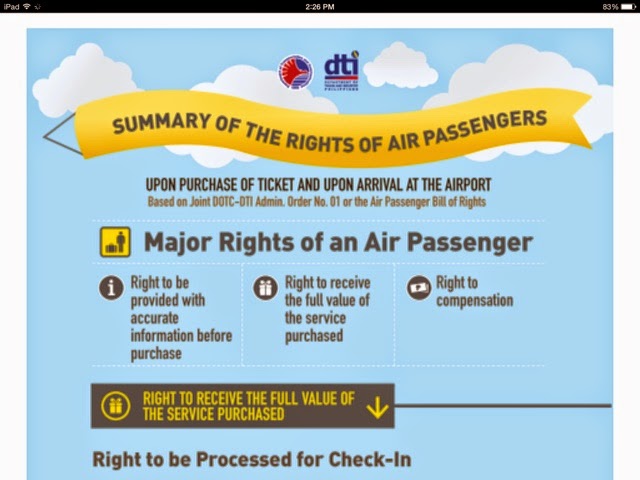
Do you know your basic rights as an air passenger? If not, this post is for you.  The following set of images would show the summary of the rights of air passengers.  Credit goes to www.gov.ph, the website of the Official Gazette of the Philippines.

Who May Not Be Charged As Accessories To The Crime?

Image
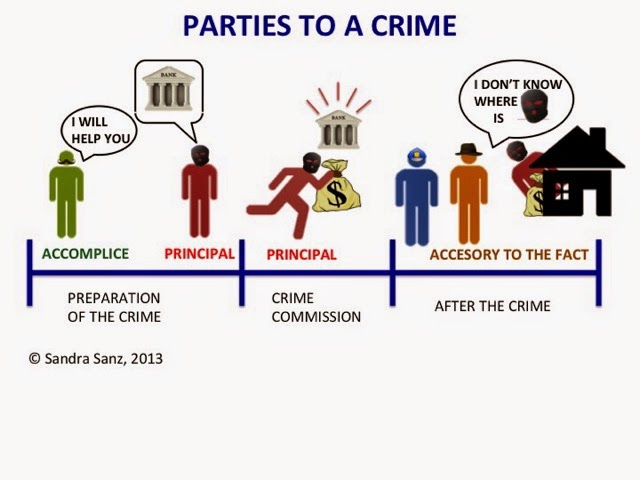
Image Credit to www.flashcards.barmaterials.com via Google. I am sure that most of us are already familiar with the term ACCESSORIES TO THE CRIME. I am hoping also that aside from hearing this term very often, we already have a grasp of what it conveys and how could we evade from committing it. The Revised Penal Code or Act Number 3815, as amended, provides a definition of accessories to the crime.  Accordingly, accessories are those who, having knowledge of the commission of the crime, and without participated therein, either as principals or accomplices, take part subsequent to its commission in the manner provided by law. Accessories are not principals nor accomplices to the crime. Accessories take part subsequent to the commission of the crimes in this manners: 1. By profiting themselves or assisting the offender to profit by the effects of the crime; 2. By concealing or destroying the body of the crime, or the effects or instruments thereof, in order to prevent its discove...